Showing posts with label England. Show all posts

Saturday, January 20, 2018

Biography of Robert Hooke

Microscopes existed in Holland by 1620. Robert Hooke and Christian Huygens were the first two scientists to make scientific use of microscope. Both designed and built two lens microscopes.

Robert Hooke
English scientist Robert Hooke (28 July 1635 – 3 March 1703) was one of the most important early chemists because his contributions would prove crucial to the birth of modern forensic science. Among many other achievements, Robert Hooke did significant development with microscopes, the first forensic instrument.

Robert Hooke also made significant theoretical and practical contributions many fields of science, including astronomy, mechanics, chemistry and physiology, geology, optics, psychology, music theory, microscopy and horology. He also did much architectural work, assisting in the rebuilding of London after the Great Fire of 1666.

In 1660, Robert Hooke investigated the phenomenon of color separation on thin transparent films, such as the colorful soap bubble. This study provided him with the rudimentary theoretically conviction that light is a wave.

In 1665, Robert Hooke proposed that atomic model of matter, based on crystalline structure and apparent transparence, indicating holes between the solid-state natures.
Biography of Robert Hooke

Friday, February 17, 2017

Ancient astronomy at Stonehenge

Stonehenge, one of the most famous archeological sites in the world, has long been associated with astronomy.

It is located in the county of Wiltshire in south central England. The construction of this monument begins around 3100 BC and continues above 10,000 years.

The positions of each stone have been carefully surveyed and mapped and the age of the monument had estimated by radiocarbon dating of associated organic remains.

An American astronomer, Gerald Hawkins, in the 1960s was one of the first to propose a theory that explained a reason for building Stonehenge. Hawkins became interested in the structure when he learned one-long established fact: that the northeast axis of the monument aligns with Sun during the summer solstice, suggesting that the site may have been used for astronomical observation.

When a smaller stone, the ‘heel stone’ is viewed through the gap in one of the trilithons, the summer solstice sun rises directly the heel stone.

He used an IBM mainframe computer to plot the positions of 175 key points: stones, stone holes, earthworks and other fixed points. Hawkins called Stonehenge a ‘Neolithic computer’ used for predicting lunar eclipses.
Ancient astronomy at Stonehenge

Tuesday, December 6, 2016

Dalton’s Law

In 1801, English scientist John Dalton realized that each gas in a mixture of gases exerts a pressure, called a partial pressure.

John Dalton (1766-1844), an English schoolteacher, made a number of important contributions to chemistry. He was the first to notice the independent behavior of gases in mixtures.

In 1803, he published a summary statement concerning this behavior that is now known as Dalton’s law of partial pressure, although the French chemist and physicist Joseph Gay-Lussac claimed that the ‘Law’ had previously been described during the French Revolution attributed it to Citizen Charles.

Dalton’s law of partial pressure states that the total pressure exerted by a mixture of gases is the sum of the partial pressures of the individual gases present.
Dalton’s Law

Friday, October 28, 2016

Discovery of Boyle's Law

Boyle’s Law is one of the laws in physics that concern the behavior of gasses. The law states that if gas is held at constant temperature, its volume is inversely proportional to its pressure.

Robert William Boyle (1627-1691) was the first to investigate the relationship between the pressure P of an enclosed amount of air and its volume V; he provides a classic example of the way in which the collection of data can lead to a functional law.

Robert Boyle is a Anglo-Irish physicist and chemist. He was born in Lismore Castle, Ireland, the 14th child of the Earl of Cork, a great Elizabethan adventurer.

He was educated at Eton, where he was one of the first of the ‘gentleman’ students and then traveled extensively on the Continent, continuing his education at Geneva.
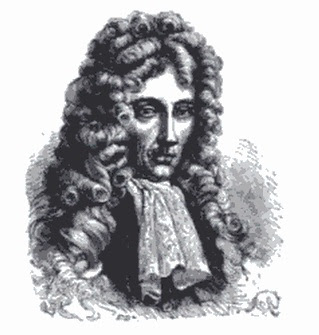
Robert William Boyle (1627-1691)
The relationship between pressure and volume was noted by two amateur scientists, Richard Towneley and Henry Power. Boyle confirmed their discovery through experiments and published the results. This statement had been asserted more precisely in a later edition of his New Experiments in the version which subsequently became known as ‘Boyle’s Law’.

According to Robert Gunther and other authorities it was Boyle’s assistant Robert Hooke, who built the experiments apparatus. Using an improved vacuum pump built for him by Robert Hooke, Boyle was able to obtain a large evacuated space in which several new experiments could be done.

The French physicist Edme Mariotte (1629-16824) discovered the same law independently of Boyle in 1676, but Boyle had already published it in 1662, so this law may, improperly, be referred to as Mariotte’s or the Boyle-Mariotte law. Marriot used a mercury barometer to establish that the ratio of the volumes of two gases is equal to the ratio of weights that exert pressure upon them – a statement equivalent to Boyle’s law.
Discovery of Boyle's Law

Wednesday, July 27, 2016

Discovery of Crab Nebula

The AD 1054 supernova remnant, the Crab Nebula, one of the brightest in history, recorded by Chinese and Arab astronomers and also by the monks of St. Gallen monastery. Crab Nebula was discovered by English physician and amateur astronomer John Bevis in 1731. One of the most active observers of the heavens in Georgian England, Bevis maintained a private observatory outside the city and about the year 1745, compiled a set of ornate star chars, the Uranographia Brittanica.
Crab Nebula
The same year that Bevis died, Crab Nebula was rediscovered by Charles Messier in 1758.  William Herschel, who observed it not long after Messier, thought he could see individual stars in the cloud.

In 1884, Lord Rosse published a first sketch of M1, and gave the name ‘Crab Nebula’ because it look a bit like a scorpion or a crab.

John Duncan found in 1921 that the nebula is expanding. In 1949, the radio astronomers Boltoin, Stanley and Slee identified the Crab Nebula as a radio source, making it the first non-solar system radio to be identified with a known optical object.

The detection of the Crab Pulsar at the centre of the Crab Nebula gave final confirmation to the theory that the core of a gravitational collapsing star settles down to the equilibrium state of a neutron star, if it is mass is inferior to the relevant Chandrasekhar limit.
Discovery of Crab Nebula

Friday, May 8, 2015

Henry’s Law of Gases by Dr William Henry

In 1805, an English Chemist William Henry (1774-1836) have an important generalization called Henry’s Law on the basis of series of observation about the quantitative affect of pressure on the solubility of gases.

Henry entered Edinburgh University in 1795, received his MD in 1807 and later specialized in urinary disease. Henry worked as a physician at the Manchester Infirmary, studying bladder stones and writing an essay on diabetes. He drifted to chemistry taking over a chemical works established by his father.

Henry devoted much of his research time to chemistry, with an emphasis on the behavior of gases.  He read one of his best-papers to the Royal Society in 1802 and published it in 1803: Philosophical Transactions of the Royal Society.

The paper describes experiments on the quantity of gases absorbed by water at different temperatures and under different pressures

This led to Henry’s Law of Gases. The Henry law states that the solubility of a gas at a given temperature is directly proportional to the pressure at which it is dissolved.
Henry’s Law of Gases by Dr William Henry

Thursday, November 6, 2014

Discovery of Proton by Ernest Rutherford

Ernest Rutherford (1871-1937) probably deserves most of the credit for the discovery of the proton.

He carried out experiments in the early 1900s in which various elements were irradiated with α-particles.

In 1909, he reported his experimental results, showing that the hydrogen nucleus is present in other nuclei a result usually described as the discovery of the proton.

Rutherford characterizes a positive particle in the nucleus about 1836 times as greater than the mass of electron. Equipment is required to accelerate protons because of their mass.

Rutherford named the hydrogen nucleus the proton, after the neuter singular of the Greek word for ‘first’.

The proton carries a 1+chanrge, equal in size but opposite in sign to the negative charge of the electron.

Rutherford was also the first to conceptualize the possible existence of the neutron.

In 1920, Rutherford proposed that the disparity found between the atomic number of an atom and its atomic mass could be explained by the existence of a neutrality charged particle within the atomic nucleus.
Discovery of Proton by Ernest Rutherford

The Most Popular Posts

Famous Scientist

History of Food Processing