Showing posts with label enzyme. Show all posts

Thursday, January 20, 2022

History and discovery of enzyme amylase

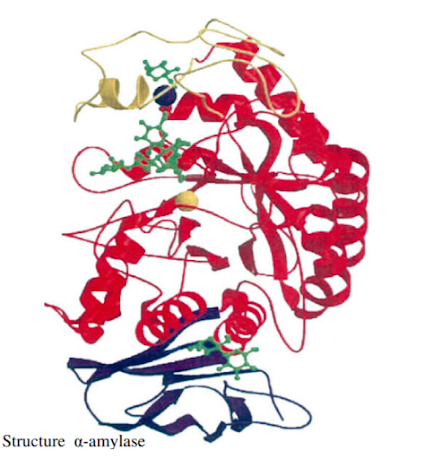
Amylases are digestive enzymes which hydrolyze glycosidic bonds of starch to glucose, maltose, maltotriose and dextrin. The history of amylases began in 1811 when the first starch degrading enzyme was discovered by Gottlieb Kirchhoff in wheat and laid down the foundation for the discovery and research on Amylase.

Kirchhoff, Russian chemist of German origin, preformed an experiment, which converted four parts of water, two parts of starch, and malt into a starch paste. This paste began to liquefy into a sweet syrup. His results showed that gluten had the capacity to convert a larger quantity of starch into sugar. Thus, Kirchhoff laid the foundation for the discovery of Amylase.

In the 20th century, Borkström's group in Sweden investigated the absorption of nutrients in human adults by transintubation techniques and found that the luminal concentration of invertase was small compared to that of α-amylase. They speculated that the major locus of this enzyme activity must be in the intestinal cells.

The α-amylases were named by Kuhn in 1925, because the hydrolysis products are in the alpha configuration. In 1930, Ohlsson discovered another amylase, which yielded a β-mannose. He named it β-amylase.

Ohlsson suggested classifying starch digestive enzymes in malt as α and β amylases according to the anomeric form of sugars formed by the enzyme reaction.

As diastase, amylase was the first enzyme to be discovered and isolated by Anselme Payen and Jean-François Persoz in 1833.

The first enzyme produced industrially was an amylase from a fungal source in 1894, which was used as a pharmaceutical aid for the treatment of digestive disorders.

Boidin & Effront, 1917 were the first to use Bacillus subtilis and Bacillus mesentericus for the production of α-amylases on commercial scale using large fermenters in submerged fermentation.
History and discovery of enzyme amylase
Tuesday, November 11, 2014

Eduard Buchner discovered the first free enzyme

The term enzyme was coined from a Greek word meaning ‘in yeast’ – it was suggested in 1876 by Wilhelm Friedrich Kuhne (1837-1900).

In 1897 the German chemist Eduard Buchner accidentally discovered that cell-free yeast extract could still convert sugar to alcohol and carbon dioxide.

He made an extract of yeast cells by grinding them and filtering off the remaining cell debris. This discovery proved that whole cells were not necessarily required for fermentation and thereby inaugurated the field of enzymology.

Buchner published his findings in the paper ‘Alcoholic Fermentation without Yeats Cells.’

In 1898 he continued his study on fermentation process in Berlin, and producing 15 papers on the topic. In one paper, ‘The Zymase: Fermentation,’ he detailed his discoveries and called the catalyst in the cell extract as zymase.

This was really the beginning of the study of enzymes and the science of biochemistry - before Buchner’s discovery scientists has believed that the reactions of life could only take place within living cells.
Eduard Buchner discovered the first free enzyme

Tuesday, June 4, 2013

Discovery of enzyme

Early discovery of enzyme is primarily associated with the knowledge of alcoholic fermentation.

Primitive tribes of tropical regions for centuries have practiced the art of meat tenderization by employing the leaves and the fruits of plants for processing meat.

In ancient times Greeks knew that if grape juice were kept at room temperature for a few days, it gets converted into alcohol.

It was not until the 19th century AD, however, that scientists addressed the question of whether the entity responsible for processes such as fermentation was a living species or a chemical substance.

But in 1857 Louis Pasteur established that the process of fermentation was closely associated with the growth and life of yeast. This concept was later disputed by J. Liebig who proposed that fermentation could take place even in the absence of living cells.

The properties and reactions of enzyme catalysis were first recognized by G.S.S Kirchhoff in 1811; however, the actual word ‘catalysis’ was coined in 1838 by Berzelius.

Freidrich Wilhelm Kuhne in 1878 coined the term enzyme (in yeast) for the substances which were earlier called ferment.

In 1897 Eduard Buchner published the observation that cell-free extracts of yeast containing no living cells were able to carry out the fermentation of sugar to alcohol and carbon dioxide.
Discovery of enzyme

The Most Popular Posts

Famous Scientist

History of Food Processing